|
|
|
El Negro's Informal Lesson
The Left Foot Clave
What is the Clave? And you want me to do what with my left foot?
The clave (pronounced klavay and referred to in the feminine form) is the key for understanding Afro-Cuban music. All the rhythms played by the numerous instruments that make up the musical piece or song is derived from her. For example, the rhythm of the bass guitar must interact with the clave in the same way as the rhythm of the piano or the horn section, even the singer. It is really the heart of the Afro-Cuban music.
We have 3 kinds of clave:
1) 6/8 or Bembe
2) Rumba Clave
3) Son Clave
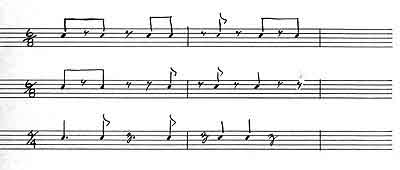
You can appreciate the Bembe or 6/8 Clave by understanding that it's a pattern strictly set on a trinary (triplets or mathematical base of 3). The Rumba Clave is born from the same time. They start trinary and then later they become 4/4.

|
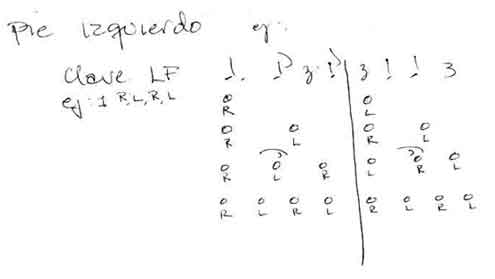
6/8 or
Bembe Clave
|
Bembe, Rumba 6/8
& Rumba 4/4
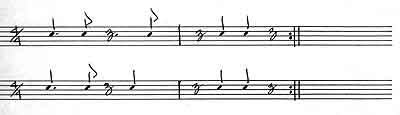
The Son Clave is a derivation of her sister, the Rumba clave. This rhythm is in a totally binary form that is determined by the displacement of the last note of the first bar.
|
Rumba
|
|
Son
|
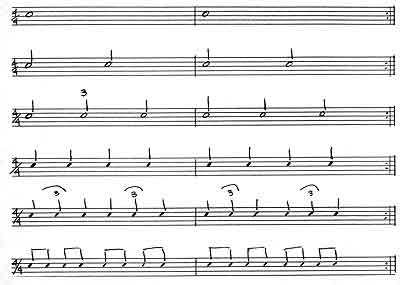
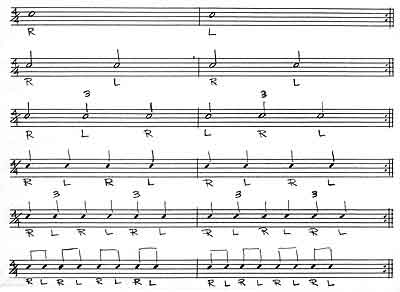
In the next exercises we will use the Rumba clave to show how these rhythms function in both ways...binary and/or trinary. This exercise must be practiced with the hands only, at different speeds and dynamics. And later doing the same with your feet.
After this you can use different combinations -
1) First between your hands and
2) then between your hands and right foot while you play the clave with that famous left foot. So now we have found the left foot!
Try these combinations!Don't forget your left foot!
|
1.
|
|
RLRL RLRL
|
|
7.
|
|
RLLR LRRL
|
|
2.
|
LRLR LRLR
|
8.
|
RRLR LLRL
|
|
3.
|
RRLL RRLL
|
9.
|
RLLL RLLL
|
|
4.
|
LLRR LLRR
|
10.
|
LRRR LRRR
|
|
5.
|
RLRR LRLL
|
11.
|
RRRL RRRL
|
|
6.
|
LRLR RLRL
|
12.
|
LLLR LLLR
|
|
|
|
13.
|
RRRR LLLL
|
I hope you enjoy, and Don't Stop..EVER!

Horacio "El Negro" Hernandez
|
|
|